How to lose fans and alienate people

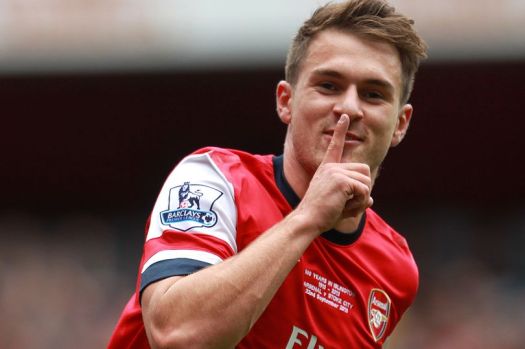
Ramsey-Stoke-Sep-2013

It’s difficult to work out what the Chartered Management Institute’s real aim was in announcing that sports talk should be banned from the workplace – but it’s unlikely it was to turn a benign, corporate membership organisation into a laughing stock.

If you missed the story, the CMI’s chief executive, Ann Francke, went on the Today programme (starts around 20 minutes in) to campaign for sports chat to be discouraged because it excludes women and can be a ‘gateway’ to ‘laddish banter’, including men bragging about sexual conquests.

There’s a lot to unpack there. It’s almost as if it’s been carefully calibrated to include something to alienate everyone. It certainly had the feel of a story tucked mischievously into the Radio 5 Live news round-up on April Fool’s Day.

I suppose by some measures it was successful. It probably did stop people talking about sport. For a short while on Monday morning in offices up and down the land, people were talking about someone trying to ban them from talking about sport instead.

Ratner’s gaffe surpassed

It’s been compared to Gerald Ratner’s gaffe of many years ago in how it has backfired but I’d say it’s even worse than that. As ill-advised as Ratner’s comments were, at least you got the feeling he was being honest.

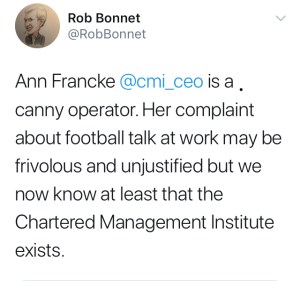
There’s a sense with the CMI announcement that it’s been cooked up specifically to get media and public attention. As the BBC’s veteran sports reporter Rob Bonnet pointed out:
 

IMG_7742

Maybe I’m being cynical. But if so, I’d like to know more about the thinking and the process that preceded the Today programme. The journey from raw idea to the CEO sitting in the BBC studio.

Was the policy debated by a committee; did it emerge from an academic paper; what are the corporate bona fides of taking such a pantomime inflammatory stance?

I can’t picture a route that doesn’t involve a Monty Python sketch. In fact, in the interview itself Ann Francke attempts to back up her argument with the claim that:

“It’s very easy [for men] to escalate from VAR chat to slapping each other on the back and talking about their conquests at the weekend.”

In the week we lost Terry Jones, this is surely one of the most comically surreal statements ever to be aired on the BBC.

A missed opportunity?

Buried beneath all the anti-sport rhetoric is a potential missed opportunity to talk about banter culture. Something that no doubt would have been useful to the CMI’s 80,000 members in their everyday management responsibilities.

But by clumsily conflating banter with men talking about sport she has trampled over this in favour of grabbing a couple of sensationalist headlines, and in the process given a mainstream audience a reason to dislike and discredit an organisation that most had probably never heard of.

Ordinarily, I’d try to avoid the cliché of calling this an own goal but there really is no other way to describe it. And in this case, it’s fitting that sport should have the last word.

 

What’s the role of comms in the ‘cancel culture’?

Cancelled-Stamp-or-Chop-on-Pap-mainEvery week someone new gets ‘cancelled’. Kevin Spacey, Woody Allen, Kanye West, Rosanne Barr are all examples of recent years.

It happens to brands too. Just last week, chic, celebrity-endorsed gyms Equinox and SoulCycle hit the skids after the owner’s plans to hold a huge fundraiser for Donald Trump were exposed.

A recent (excellent) article on The Quietus about Michael Jackson’s legacy gave this definition:

“Cancel culture, or call-out culture, is a recent phenomenon by which artists or public figures are immediately sent to a perpetual Coventry for actions or thoughts deemed inappropriate by the public…”

There are deeper, socio-cultural currents at play too, as communications strategist and writer Camonghne Felix, explains:

“..cancellation isn’t personal but a way for marginalized communities to publicly assert their value systems through pop culture.”

 The moral question

Considering the role of communications in the cancel/call-out climate currently throws up plenty of questions and precious few answers.

The first question seems to be: is it even a communications issue at all? Depending on the nature of the ‘crime’ it might be a purely moral concern, a black-and-white issue of right and wrong that comms people shouldn’t get involved with.

But if there is scope for giving strategic advice, there’s the consideration of what’s at stake, as communications professionals, if we take the job on. Is an attempt to rehabilitate a person or an organisation a display of aligning with their opinions?

Are we damaging our own professional reputations by being associated or can we exist outside the issue? We’re not in the legal profession, we can’t wrap ourselves in the same cloak of neutrality and objectivity, so judgment is everything.

And at a personal level, can we separate our own views from those of the subject? We might not approve of the ‘crime’ but does that mean we can’t help the individual or brand to rehabilitate? And, conversely, what if we believe they have done no wrong – are we really best placed to advise them?

The answers to these questions are likely to be different in every instance.

Can communications reverse cancellation..?

Moral quandaries aside, on the question of whether a strategic communications approach can even effect any change in these circumstances, it’s unclear whether it holds any power at all.

Until recently, the response of the disgraced celebrity in Western culture would follow a predictable pattern. The path of transgression, followed by contrition and leading to ultimate redemption for most of those in the public eye who have mis-stepped, mis-spoken or smoked-but-not-inhaled is well trodden and has been for the past generation.

But cancel culture doesn’t seem to offer such a formulaic way back into the warm glow of public approval. Some people disappear into the wilderness and don’t return, while others are luckier. For example, Mel Gibson came back, Kevin Spacey’s still there.

Closer to home, Danny Baker was cast out three months ago but a new episode of his podcast landed only this morning, which must indicate some perceived reduction in hostilities, if only from his co-host, Gary Lineker.

Maybe it’s an issue of the severity of the misdemeanour, the time elapsed, how sincerely an apology is adjudged to be, or a softening or simple forgetfulness on the part of the audience. Or all of these things. Or something else entirely.

Watch, wait and learn

Public approval has been democratised to the mass audiences of social media who exercise it by withholding attention (unfollowing) or through commercial pressure (not buying the product). This is what gives cancel culture its (at least from a communications perspective) mercurial and unpredictable power.

There’s not an identifiable pattern yet of how, once someone has been cancelled, to move the debate on, and perhaps there never will be. So maybe the only role for comms people for now is to watch, wait and learn.

And, of course, to make sure none of their clients get cancelled in the first place.

Steve Lacy’s album launch is plane genius

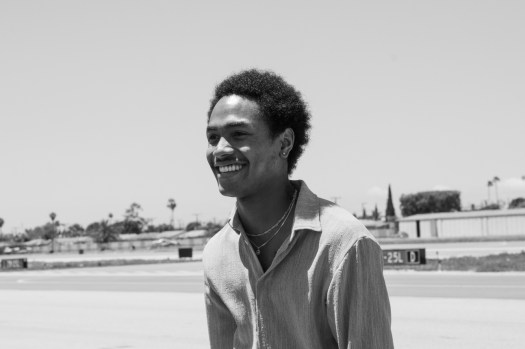
steve-lacy-airport-10
Photo: Matt Vinas

The idea to stage Steve Lacy’s debut solo album release party at Compton airport in Los Angeles was a masterstroke.

Lacy is a US guitarist and singer-songwriter who emerged from the band The Internet. As a producer he’s worked with Kendrick Lamar and Solange, amongst other heavyweights.

It might be an unconventional choice of venue but an airport is the perfect metaphor for an artist who’s ready for take-off but by most measures has already well and truly arrived.

Homecoming hero?

Arriving at the launch by helicopter Lacy was met by crowds of his assembled fans who’d thronged the airport to greet him.

So he finds himself in the paradoxical position, on the day of his debut solo album’s release, which he hasn’t yet toured or performed, of receiving the homecoming welcome of a conquering hero.

It also happened to be his 21st birthday, the traditional take-off point into adult life proper. But Lacy has long since come of age.

He was nominated for a Grammy at age 17 for his work with The Internet and won one at 20 for his production on Kendrick Lamar’s DAMN album.

For most, this calibre of achievement would define, not prefigure, a life’s work.

steve-lacy-airport-2
Photo: Matt Vinas

Get hold of a boarding pass and buckle in

Whether Steve Lacy continues to deliver on his musical potential we’ll find out over the next few years but it’s the snapshot of where he’s at right now that’s the most interesting from the perspective of his public profile.

He’s at the fulcrum that all those who go on to become globally famous musicians encounter in their career, when they’re poised between good and maybe greatness.

Elton John captured it recently writing about the Rocketman biopic: “But when it happened, it went off like a missile: there’s a moment… when I’m playing onstage in the Troubadour club in LA and everything in the room starts levitating, me included, and honestly, that’s what it felt like.”

Of course, it’s mainly about the music but public perception plays a big part in the process too.

When the wider world spots an artist at the tipping point between loyal fanbase and global stardom it creates the clamour to get hold of a boarding pass and buckle in before the Boeing screams off down the runway and catapults the star into a world where they suddenly belong to everyone.

It’s the surge of interest that can power a stratospheric take-off in any artist’s career.

But, what do you do when your talented young artist’s career has taken off and landed successfully a few times already, and looks set to do so again?

You stage the promotion in an airport and let the audience work it out for themselves.

Listen to the album here

It’s got to be… Ferfect

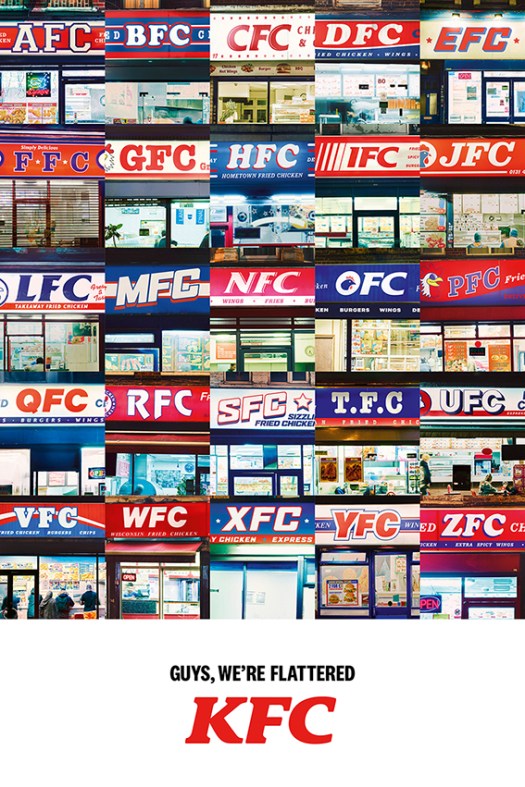
KFC put out another great, self-aware ad last month.

KFC15

It took an idea we’ve all nearly had and executed it simply and perfectly. Fresh but familiar, like the first time you hear ‘Penny Lane’ by The Beatles.

The message is that imitation is the sincerest form of flattery. Which is appropriate, because KFC themselves are not the first fried chicken chain to take this tack with their promotions.

Anyone local to South London will be aware of the stranglehold the mighty Morley’s have over the fried chicken market on this side of the city.

They (or a particularly ardent fan of theirs) have been calling out the copyists of their branding for years on their good-natured Morley’s Or Less Twitter account.

High-street fried chicken seems to be a market where everyone wants to look exactly the same, but slightly different.

Mr Chicken RIP

One man who enjoyed great success out of this situation before he passed away a few years ago was Morris Cassanova, or Mr Chicken as he was known.

Morris is believed to have single-handedly designed up to 90% of the chicken shop signs in London. That’s a lot of ground to cover with such a narrow palette of concepts to recycle (red, white and blue colour scheme; a chicken’s head; maybe an American city).

Which I suppose makes it inevitable that sometimes there’ll be duplication of designs, accidental or otherwise.

Take my local chicken shop. They used to be called ‘Perfect Fried Chicken’, until a couple of years ago when they rebranded. To ‘Ferfect Fried Chicken’. That’s right, ferfect.

Ferfect

I like to imagine their Head of Legal receiving an urgent cease-and-desist from the ferocious lawyers over at Perfect Fried Chicken and having to come up with a solution sharpish.

So, they just bolted an ‘F’ over the ‘P’ and kept right on frying. And it seems to have worked; they’re doing as brisk business as ever in there.

As well as keeping the lawyers at bay, that second ‘F’ in perfect also offers up a tempting new creative opportunity…

I doubt they’ve got KFC’s advertising budget so if they wanted a new strapline, they can have ‘Too F-in’ perfect’ for free.

If you need any support with your fried chicken puns or any other aspects of your communications, I’d be happy to help

Lush: commendable stance or commercial suicide?

lush

Lush’s decision to quit social media is an interesting one. And gives me the opportunity to write about the topic without having to use budget-boozy, Brexity Wetherspoons (who made the same move last year) as an example.

(Although, it’s hardly comparable. Wetherspoons had a Twitter following of 44,000 people at the time. When any marketing is an attempt to project your brand beyond its immediate vicinity, this is probably fewer than the combined number of customers sitting in Wetherspoons pubs at any given time of day..)

Anyway, back to Lush, who said this week they were closing several UK social media accounts, with the reasoning that:

“Increasingly, social media is making it harder and harder for us to talk to each other directly. We are tired of fighting with algorithms, and we do not want to pay to appear in your newsfeed. So we’ve decided it’s time to bid farewell to some of our social channels and open up the conversation between you and us instead.”

There’s something refreshingly subversive about, of all things, a cosmetics brand coming off a medium as visual as social but I’m not sure I buy their reasoning. Harder to talk to customers directly? Closing social to open up conversations better? Eh?

Lush have a tradition of going against the grain, and they’re certainly not shy of taking a stand when they feel it’s the right thing to do.

But for a brand with well over 1 million combined social followers and which, other than some heat over a campaign last year, doesn’t attract much in the way of social storms, this move has the feel of a solution looking for a problem. A brave campaigning crusade against an injustice that doesn’t exist.

And when your business is, ultimately, cosmetics and not campaigning this might turn out to be an issue.

One thing they have done is remind us, even in an Instagram-hungry industry like theirs, that social media is a choice.

From some of the reactions to their announcement you’d think it was an obligation or duty to maintain a social media presence. But, as long as they are comfortable with the consequences of their absence from these platforms, no brand has to use it.

Whether or not this ends up being the right commercial decision for Lush, we’ll see.